-

Al Baseer Hospital
- Sep 24. 2025
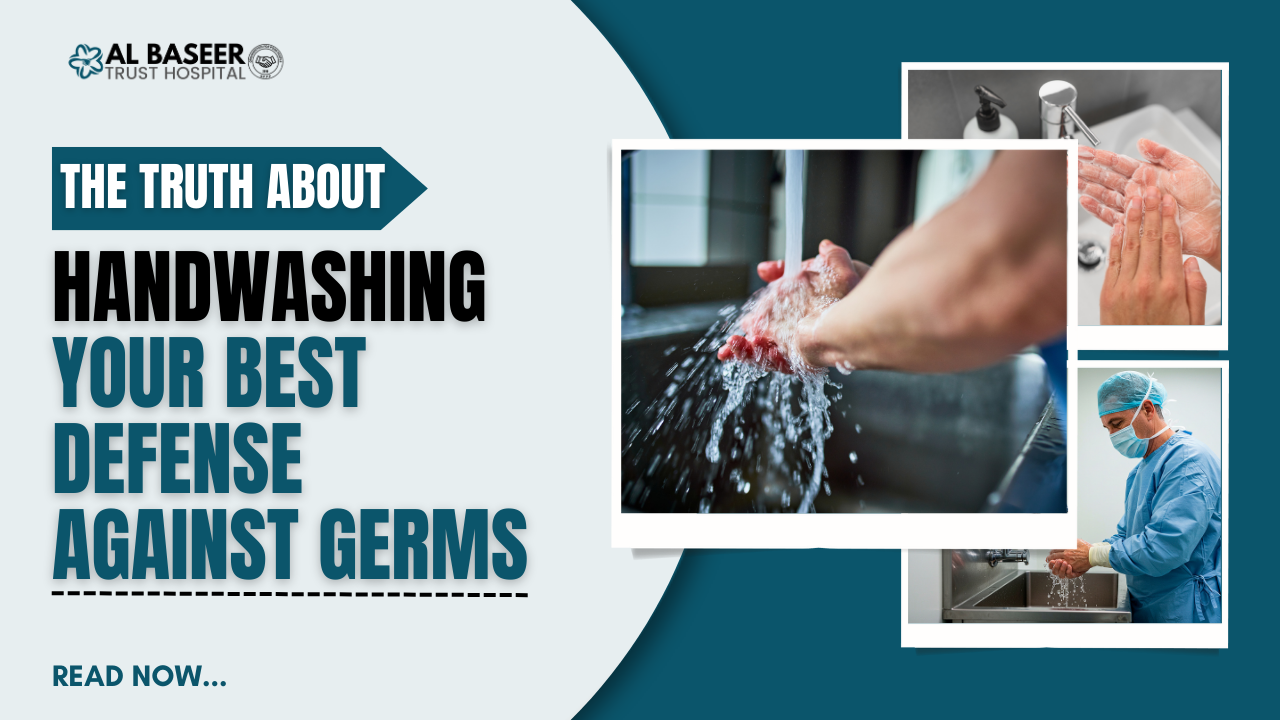
The Truth About Handwashing: Your Best Defense Against Germs
Imagine this: You've just arrived home from the grocery store. You handled the cart handle that was touched by hundreds of people in front of you, scrolled through your phone while in line, dealt with some cash, and opened your door with the same hand. Unbeknownst to yourself, you've brought an entire army of unseen germs back home.
Introduction
Imagine this: You've just arrived home from the grocery store. You handled the cart handle that was touched by hundreds of people in front of you, scrolled through your phone while in line, dealt with some cash, and opened your door with the same hand. Unbeknownst to yourself, you've brought an entire army of unseen germs back home.
Here's the million-dollar question: what's the very first thing you should do? If you didn't even consider washing your hands, don't worry, you're not alone. Most of us don't realize just how powerful this simple habit is. Let's learn the truth about handwashing and why it's your body's first line of defense against germs.
Why Handwashing Works: The Science in Simple Words
Now, let's make this simple without the bland textbook. Soap does not eradicate germs whatsoever; it deceives them.
A soap molecule is somewhat like a matchstick: one end loves water (hydrophilic) and one end loves fat (hydrophobic). Viruses and bacteria have a fatty coating, a sort of protective jacket. The fat-loving side of the soap sticks to the jacket and rips it off. If the "jacket" of the germ is destroyed, it cannot survive. It is similar to popping the bubble of a germ.
But wait, soap can't do it alone. That is where friction comes in. When you rub your hands together, you're disrupting dirt, oils, and germs that are lodged in tiny crevices in the skin. The soap molecules trap them, and water washes them away.
And what of plain water? Consider your failed effort to wash a greasy pan with just water. It doesn't work; you simply smear the grease around. That is what occurs when you don't use soap. Soap breaks down the oils, and water carries the mess away down the drain.
The Gold Standard: WHO’s 6-Step Technique (Explained in Detail)
We all believe that rubbing palms together for some time is enough. Spoiler alert: it is not. The World Health Organization (WHO) promotes a 6-step technique touching all areas.
Step 1: Palms
Rub your palms together to distribute soap and break up surface dirt. This is your launching point.
Step 2: Back of Hands & Between Fingers
Now turn your hands over and clean the backs, interlacing your fingers. Germs are fond of nesting between your fingers like children at hide and seek.
Step 3: Interlace Fingers
Lock your fingers, palm to palm. This way, you clean around the knuckles and into those pesky crevices.
Step 4: Thumbs
Thumbs are the silent workers; they touch everything but don't get scrubbed often. Wrap your fist around your thumb and rotate.
Step 5: Fingerbacks & Nails
Bacteria love nails. Press fingertips into your opposite palm and rub in circles. This hack gets beneath your nails without using a brush.
Step 6: Wrists
End strong by washing your wrists. Healthcare professionals know germs creep on higher than we know.
Timing: 20 Seconds
Here's the catch: this entire process must take a minimum of 20 seconds. Not sure how long that is? Sing "Happy Birthday" twice, or if that's too boring, sing the chorus of your favorite song. Trust me, it makes handwashing a mini dance party.
Busting Common Myths & Addressing FAQs
Myth 1: Antibacterial soap is better.
Not exactly. Regular soap works just as well. Too much antibacterial soap might make bacteria resistant.
Myth 2: Hot water kills more germs.
No. Water that is too hot can damage your skin and make it weaker. Warm, comfortable water works just fine.
FAQ: Soap vs. sanitizer?
Hand sanitizer is great to have when you're on the go, but it won't eliminate dirt, grease, or tenacious germs like norovirus. Soaps and water are still the way to go.
FAQ: How often should you wash?
After the bathroom, before meals, after a cough or sneeze, after pet handling, after being out in public, the list continues, but put this way: if you've touched someone else's thing, rinse it off.
Everyday Scenarios Where Handwashing Matters Most
After using the bathroom (self-explanatory, but often neglected).
Prior to food handling or consumption.
After blowing the nose, coughing, or sneezing.
After touching cash, shopping cart handles, or handrails on public transportation.
After handling cash, shopping bags, or public transportation rails.
After playing with dogs and cats.
Each of these moments is like a "checkpoint" for germs. Wash at the checkpoint, and you don't allow them to move forward.
Handwashing for Families and Kids
Getting kids to wash their hands properly is like getting kids to eat broccoli. The trick? Make it fun.
Make the 20 seconds a timed race.
Develop a silly handwashing tune.
Place colorful stickers in the bathroom for reminders.
And the golden rule? Kids copy adults. If you wash your hands properly, they'll follow suit.
Healthy Hand Hygiene Habits: Going Beyond the Basics
Moisturize: Excessive washing of your skin dries your skin and makes it crack. Cracked skin is similar to an open door for germs. Carry a travel-sized hand cream with you.
Nails: Cut them regularly. Long nails are just luxury condo buildings for bacteria.
Personal towels: Don't share towels with someone else. A wet shared towel is essentially a hotel for germs.
Gloves: They are useful, but they are not a handwashing replacement. Germs can still cling to gloves, and when you take them off, they may jump onto your skin.
A Personal Perspective (Anecdote)
I'll never forget my first microbiology lab. We swabbed our hands both before and after washing. Before we washed, the petri dish was like a little jungle of bacteria. After washing correctly, it was nearly spotless. That simple observation made me realize that handwashing wasn't just a habit, it was science in action.
The Bigger Picture: Handwashing and Public Health
Handwashing and Public Health
Handwashing is not about you. It's about keeping your loved ones, your colleagues, even strangers at the supermarket safe.
During the COVID-19 pandemic, handwashing became an international headline for a reason, and it slowed the pandemic and saved lives. In hospitals, it keeps people from getting infections and saves thousands of patients annually.
Consider it: washing your hands, something as mundane as that, is one of the most effective tools in contemporary public health.
Conclusion
Hand washing is simple, it's free, and it's pitifully effective. With each wash, you're closing the route of germs' entry into your body and your community. It's one of the only habits where small effort gives giant protection.
So next time you press the elevator button or shopping cart, remember: lather on, scrub hard, and down the drain go those germs.
Leave a Replay
Please login to leave your comment




Comment (0)